
Margin Optimization vs Yield Maximization: A Smarter Fertilizer Strategy
Why the most profitable fertilizer rate is rarely the highest possible yield - and how AI-driven soil intelligence helps identify the economic optimum.

For decades, fertilizer strategy has been built around a simple objective:
Maximize yield.
Higher yield meant higher revenue.
Higher revenue justified higher input.
But modern agriculture operates under very different economic realities:
- Volatile fertilizer prices
- Fluctuating grain markets
- Rising operational costs
- Increasing environmental regulation
- Spatial variability inside fields
In this environment, the objective shifts from maximizing yield to optimizing margin per hectare.
And that shift fundamentally changes how fertilizer decisions should be made.
The Economic Difference: Yield vs Margin
Yield maximization asks:
What input rate produces the highest possible output?
Margin optimization asks:
At what input rate does additional fertilizer stop paying for itself?
The difference lies in the law of diminishing returns.
Every crop response curve follows a pattern:
- Initial fertilizer application increases yield significantly.
- Additional input increases yield more slowly.
- Beyond a certain point, extra input produces minimal or no economic gain.
The economically optimal rate is not at the peak of the curve.
It is the point where additional fertilizer no longer appears economically justified once yield response, input cost, operational cost, timing, and risk are considered.
Applying fertilizer beyond that point may increase yield slightly - but reduce profitability.
Why Uniform Application Often Misses the Economic Optimum
Traditional fertilizer programs assume uniform soil conditions across the field.
But calibrated soil scanning consistently reveals:
- High-reserve zones with limited response potential
- Deficient zones with strong yield response probability
- Clay-driven nutrient fixation areas
- Sandy soils with leaching risk
Applying one rate across heterogeneous soil creates two problems:
- Over-application in high-reserve areas
- Under-application in responsive zones
Both reduce margin.
This is where Terra Oracle AI changes the decision framework.
From Soil Variability to Economic Simulation
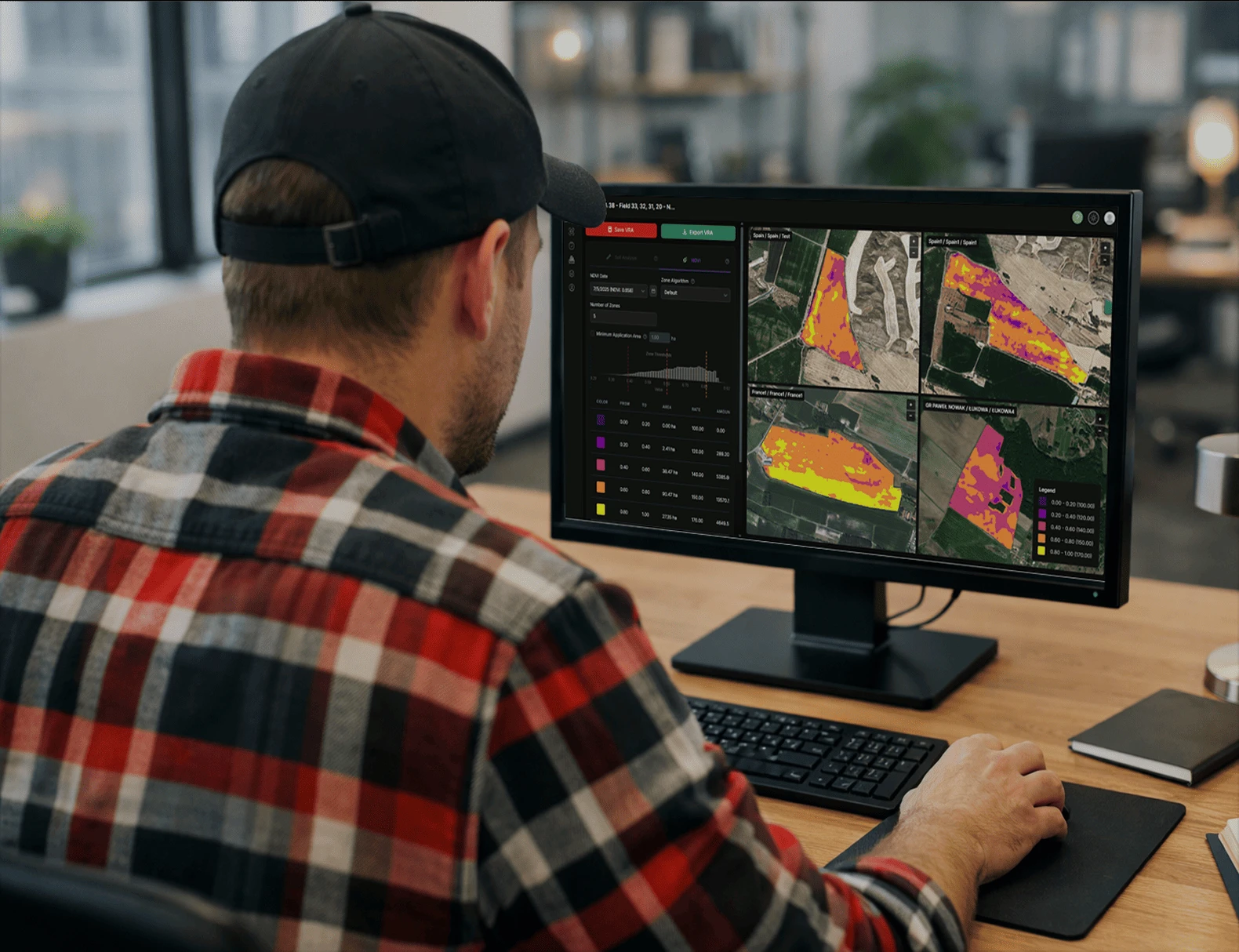
On the Terra Oracle AI platform, margin optimization can integrate:
- Calibrated nutrient maps
- Soil texture and CEC
- Crop type and growth stage
- NDVI trends
- Fertilizer prices
- Grain prices
- Weather forecasts
- Field operations and application history
- Fuel usage and other operational cost signals
Instead of asking, “What rate maximizes yield?” the system helps evaluate:
- Likely yield response per zone
- Probability of response under current soil conditions
- Required yield increase to justify additional input
- Risk-adjusted return scenarios
- Whether operational realities support action now or later
This shifts fertilizer strategy from agronomic assumption to economically informed decision support.
Practical Example: Nitrogen Decision
Consider winter wheat:
- Nitrogen cost: €0.95/kg
- Wheat price: €220/t
Each additional 10 kg N/ha costs €9.50 in fertilizer alone.
To justify that cost, yield must increase by at least:
$$ \frac{9.5}{220} = 0.043\ \text{t/ha} $$
If Terra Oracle AI indicates that in a clay-heavy, high-organic-matter zone the likely yield gain from an additional 10 kg N is only 0.02 t/ha, the input may not be economically justified.
In a sandy, nitrogen-responsive zone with strong NDVI suppression, the projected gain might be 0.08 t/ha, making the same input more likely to pay.
The recommendation becomes zone-specific, not uniform.
In practice, the Advisor can go further by considering application timing, field access, fuel use, recent operations, and any local information the user adds that may not yet exist in the system.
Why Yield Maximization Can Reduce Profit
Applying fertilizer beyond economic optimum often:
- Increases input cost without proportional revenue gain
- Elevates leaching risk in light soils
- Creates lodging risk in cereals
- Reduces nitrogen-use efficiency
In high-input systems, chasing maximum yield may actually narrow margins - especially under volatile pricing.
Margin optimization stabilizes profitability even when market conditions shift.
The Role of AI in Identifying the Economic Optimum
Manually calculating optimal rates across dozens of zones is impractical.
AI can evaluate simultaneously:
- Soil nutrient sufficiency thresholds
- Diminishing return response curves
- Historical yield performance
- Current NDVI expression
- Weather-driven risk
- Economic break-even points
- Operational constraints and cost context
It allows users to simulate scenarios such as:
- “What if nitrogen price increases 15%?”
- “What if yield target drops due to drought risk?”
- “Is aggressive correction justified this season or should we phase over 3 years?”
This transforms fertilizer planning from a static recommendation into a dynamic strategy shaped by field data, economics, operations, and user input.
Multi-Year Soil Correction Strategy
Margin optimization does not always mean reducing inputs.
In severely deficient zones, aggressive correction may produce strong economic return over multiple seasons.
Terra Oracle AI allows users to model:
- Short-term margin
- Multi-year soil rebuilding
- Conservative vs accelerated correction paths
This supports structured capital allocation rather than reactive fertilization, while still allowing the user to apply agronomic judgment where field realities are not yet fully visible in the data.
Environmental and Regulatory Alignment
Margin optimization often aligns with sustainability goals:
- Reduced over-application
- Improved nutrient-use efficiency
- Lower runoff risk
- Better nitrogen balance
In many regulatory environments, economically disciplined rates also support better compliance outcomes by reducing unnecessary application and improving nutrient-use efficiency.
Precision becomes both profitable and responsible.
A Smarter Fertilizer Strategy
Yield maximization focuses on the biological ceiling.
Margin optimization focuses on the economic optimum.
With calibrated soil intelligence and AI-assisted modeling:
- High-reserve zones receive less input
- Responsive zones receive targeted correction
- Risk can be evaluated more explicitly
- Profitability becomes easier to assess before action is taken
Precision agriculture is not about applying more technology.
It is about applying the right input, in the right zone, at the economically justified rate.
That shift - from yield obsession to margin discipline - is what defines smarter fertilizer strategy in modern agriculture.
And it is where Terra Oracle AI delivers real value:
Turning soil variability, economics, operations, and user input into more structured and financially informed decisions at scale.